



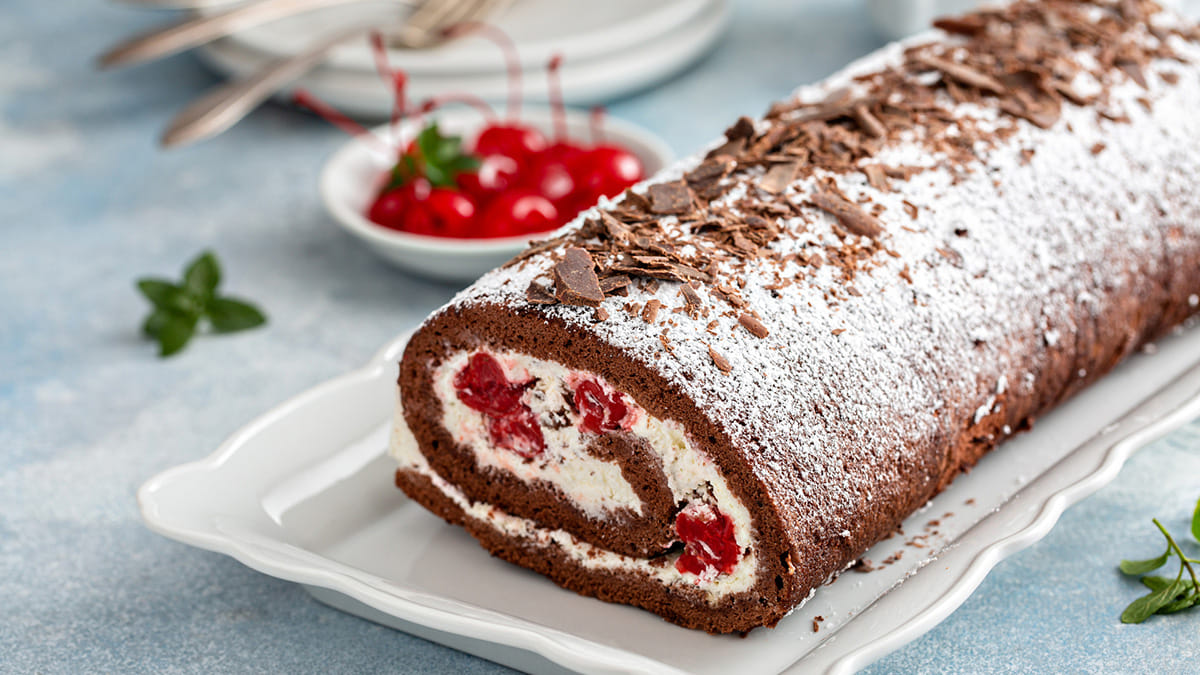
Want to roll a yule log cake without it breaking? Here is the short ‘n’ sweet answer. Curl the sponge up while it’s still warm. Use a clean tea towel that’s dusted with cocoa or icing sugar. Then let it cool inside that spiral so it learns its new shape. A sponge that cools flat goes stiff and snaps the second you bend it. That’s the heart of it.
I’ve baked log cakes many December’s for years now. Almost every crack I’ve seen came from one of 3 rookie mistakes. The cake sat in the oven too long. It waited too long before the first curl. Or the batter got stirred too hard. Fix those 3 and the rest is easy. Let’s go through each one so your Christmas table gets a bûche that looks like it came from a Paris bakery window!
Why Does a Log Cake Crack?
A bûche de Noël uses a very thin sponge. It has plenty of eggs and only a little flour. Fresh from the oven it’s soft and bendy. As it cools it dries out and firms up. A stiff sponge and a tight curl just don’t get along.
Cookbook author Anne Willan trained at Le Cordon Bleu in Paris and boiled this down in a 1989 cookbook. Her top rule for rolling a cake without splits is to never overbake it. Almost four decades later that’s still the best tip out there.
Here are the three usual troublemakers:
- Too much heat. A thin sponge needs only 10 to 12 minutes. Two extra minutes can turn it from bendy to brittle.
- Too much waiting. Baker’s we’ve talked to warn that a fully cold sponge splits very easily once you try to bend it around a filling.
- Too much stirring. Whipped eggs hold tiny air bubbles. Stir hard after whipping and those bubbles pop. A flat batter makes a dense sponge that breaks.
Where Did the Log Cake Come From?
The cake is younger than most folks think. According to National Geographic, pastry chef Pierre Lacam is widely credited with printing the first bûche de Noël recipe in 1890. It sat inside a giant book of 1,600 recipes. Before that the “log” was a real one burned in the fireplace at midwinter for luck and warmth. So your dessert is a sweet nod to a very old habit. Today you will spot one in bakery windows from Paris to Quebec and on plenty of tables across the UK and the United States.
What Equipment Do You Need?
The curl happens fast so set up first.
- A rimmed baking sheet. In the United States this is a jelly roll pan of about 10 by 15 inches. In the UK a Swiss roll tin of about 23 by 33 cm does the same job.
- Baking parchment (baking paper in the UK) to line the pan, plus a light grease.
- A thin cotton tea towel. Fluffy ones leave lint behind.
- A sieve for dusting.
- Eggs at room temperature. They whip up taller than cold ones.
Pan size matters more than most people think. In a King Arthur Baking post about perfecting a bûche de Noël the writer stresses using the exact pan size in the recipe. A pan that is too big gives a thin cake that dries out fast. A pan that is too small gives a thick one that will not bend properly. From our own baking tests we’ve found that you should aim for a layer about half an inch (1 cm) deep.
How Do You Roll It Step by Step?
Ready to roll a yule log like a pro? Work through these steps in order. I keep a phone timer running the whole time because speed is the secret ingredient here.
1) Whip the eggs. Beat the eggs and sugar for 5 to 8 minutes until thick and pale. Lift the beaters. The batter should fall in a ribbon that rests on top for a few seconds. That foam is the frame that holds your cake together.
2) Fold in the dry mix. Add flour and cocoa in two or three rounds. Use a big spatula and sweep from the bottom up. Stop the moment the dry streaks vanish.
3) Bake just until set. Go for 350°F (180°C or about 160°C fan) for 10 to 12 minutes. Touch the top lightly. If it springs back it is done. Pull it out right away.
4) Dust the towel. While the cake bakes lay the towel flat. Sift cocoa over it for a chocolate sponge or icing sugar for a vanilla one. This stops sticking and adds a little flavour.
5) Flip it fast. Slide a knife around the edge. Tip the warm cake onto the towel. Peel off the parchment slowly.
6) Wrap it up warm. Start at a short end and curl the cake and towel together. Keep it snug but not tight. Think cozy burrito and not tight sleeping bag. The Daily Meal explains that this first curl keeps the sponge pliable so it can take cream or jam later without breaking.
7) Let it cool coiled. Rest it seam side down for at least 30 minutes until it feels fully cool.
8) Unfurl and fill. Open it gently. Spread a thin even layer of filling. Leave a small bare strip at the far end so nothing squeezes out.
9) Curl it again. This time skip the towel. The sponge now remembers its bend so it follows along with ease. Trim the ends on a slant for a neat look.
10) Dress the log. Cover it with chocolate frosting. Drag a fork along the length to make bark lines. Dust with icing sugar for snow.
Want exact amounts to follow along? Our Christmas log cake recipe takes you from the first egg to the last sprinkle.
Which Fillings Work Best?
Thin and level wins every time. King Arthur Baking’s advice is to keep the layer slim and press any berries or chopped bits into it so they don’t poke up and split the sponge as you curl it.
Whipped cream is the classic pick. In the United States heavy cream must hold at least 36% milk fat. In the UK double cream starts at 48%. Either one whips up nicely and a spoon of icing sugar helps it stay firm. Buttercream and ganache give you a sturdier log if you need to carry it to a party. In my experience a coffee buttercream is the one people ask about afterward.
When I’m not looking to make something overly sweet like buttercream, my own personal favourite is a mix of lightly sweetened whipped cream with mascarpone. Everyone always loves that classic holiday flavour in our homemade desserts during the festive season.
Small Tweaks That Make a Big Difference
A few top tips from our home kitchen can save you a lot of stress.
- Swap some butter for oil. Oil stays liquid when the cake cools so the sponge stays soft. From our own test’s and experience we found roll cakes made with butter break more easily as they cool.
- Use an oven thermometer. Ovens often run hotter or cooler than the dial claims. A cheap thermometer saved more of my cakes than any other trick.
- Set the timer for 9 minutes. Your first peek often shows a sponge that is nearly done.
- Keep everything within reach. Lay out the towel, sieve and knife before the oven door opens. Then you can roll a yule log in under two minutes from oven to towel.
- Go light on filling. Heavy fillings add weight and tug at the sponge on the second curl.
Does It Work Differently in the UK and the US?
The method is the same on both sides of the Atlantic. The names and shopping lists change a little. What a British baker calls a Swiss roll an American baker calls a jelly roll. Elsewhere you will hear roulade or roll cake. All of them are thin sponges curled around a filling.
- Sugar: British recipes often call for caster sugar. In the United States granulated sugar works fine and superfine sugar is a nice bonus.
- Flour: Self raising flour is common in UK kitchens. US bakers reach for all purpose. Both work because the lift mostly comes from whipped eggs.
- Cream: Double cream in the UK and heavy cream in the US both whip well.
- Temperature: Check whether your recipe speaks Celsius or Fahrenheit before the sponge goes in.
How Can You Fix A Cracked Log Cake?
Picture this. It’s Christmas Eve and guests arrive in an hour. A crack runs right across the top of your log. Take a breath. It happens to all of us and it’s very fixable.
- Small cracks: Frosting is edible glue. Press the edges together and cover the spot with chocolate frosting.
- Big cracks: Pipe a stripe of whipped cream or ganache over the split. Then add meringue mushrooms or a few cranberries on top.
- A cake in pieces: Cut it into chunks and layer them in glasses with cream and berries. Call it a trifle and watch it vanish.
Bark lines and a snowy dusting of sugar hide a lot. Even bakers and chef’s we’ve talked to admit that they see seasoned pros still get cracks now and then. No one I know would ever turn down a slice because of one though.
How Far Ahead Can You Make It?
A good way to cut holiday stress is to bake early. You can roll a yule log 1 or 2 days ahead and keep it wrapped well in the fridge. Add the final dusting of sugar just before serving so it looks fresh.
One safety note for cream filled cakes. The USDA says perishable foods should not sit out for more than 2 hours. That drops to 1 hour when the room is above 90°F (32°C). So bring the log out near serving time and tuck leftovers back in the fridge soon after.
Planning your whole holiday baking list? Our Christmas Cookie & Dessert Planning Guide shows what to bake and when.
Quick Answers to Common Questions
Not the first time. A cold sponge has already set and will split. Always do the first curl while the cake is warm. After that it holds its bend and you can fill it at room temperature.
The towel needed more dusting. Sift on a thick even layer of cocoa or icing sugar. A light cotton towel works better than a thick terry one.
Not always. Some bakers use damp crumpled baking paper instead. One Baker we know calls this a tried and true way to keep the sponge moist and bendy. For a first attempt I still suggest the towel method because it is more forgiving.
No shame in that. Our Christmas holiday cupcakes give you the same festive feel with zero rolling.
Final Thoughts
Once you know the warm curl trick it’s hard to go wrong. Bake until the sponge springs back. Flip it onto a dusted thin cotton towel. Coil it up and let it cool. That’s how you roll a yule log like a pro that stays smooth from the first slice to the last. Now grab your whisk and give it a go. Your Christmas table will thank you.